A
very mild weather pattern for early-December standards has engulfed a
large swath of the Lower 48 states. Temperatures will soar up to 30
degrees above early-December averages through this weekend as the mild
air spreads from the western and central states to the East Coast.
For
some locations, the low temperatures this week will be as warm or even
warmer than the average high for this time of year. In addition, more
record highs and record warm low temperatures will likely be set through
the weekend.
Below are the forecast details and a recap of the records so far.
Cold Air Stays Bottled Up North
As
we start meteorological winter, which runs from Dec. 1 through Feb. 29,
true arctic air remains locked up in extreme northern Canada, well to
the north of the U.S. border and even well north of all the major
Canadian cities.

Current Canada/Northern U.S. Temperatures
While
December is early in the winter season, it is quite common for chunks
of bitterly cold air to reach the U.S. during the first half of the
month.
However, most computer model forecast
guidance shows no such thing happening right into the middle of this
December for the eastern two-thirds of the U.S. and Canada, as the
arctic jet stream remains well to the north in Canada.
Although
some colder air should reach the western and central states later this
week, the air mass is projected to be fairly modified, meaning that the
coldest air still remains locked up in northern Canada. The result may
only be a drop to near or slightly below average in terms of
temperatures.
(Forecast: Denver | San Francisco | Seattle)
Forecast This Week

Forecast Highs Compared to Average
There are no signs of any major blasts of cold air reaching the U.S. in the near future.
Through
this week, the relative warmth is likely to continue. The most
unseasonable warmth is forecast across the central U.S., but that warmth
should eventually spread to the East Coast by late in the week and this
weekend.
High temperatures will be 10 to 30 degrees
above average in many locations across the country this week. Some daily
record high temperatures may be set as well, particularly this coming
weekend.
Low temperatures will be up to 35 degrees
warmer than average in some locations at times this week. Some areas
will see low temperatures that will be warmer than their average high
temperatures.
One example is Minneapolis where the
average high for mid-to-late this week is in the upper 20s. Low
temperatures will only drop into the 30s this week with record warm low
temperatures possible (current record is 34 on Thursday and 35 Friday).
Low
temperatures in Kansas City will likely bottom out in the 40s at times
Thursday-Saturday, and the average high for this time of year is in the
lower 40s.
Buffalo, New York, will see low temperatures
in the middle to upper 40s to potentially the low 50s Thursday-Monday.
This is several degrees above their average high this time of year which
is in the upper 30s.
Thursday through Saturday
morning, temperatures are not expected to drop below the freezing mark
for most areas east of the Mississippi River, with the exception of
parts of Maine and possibly the Upper Peninsula of Michigan.
Numerous daily record warm low temperatures will likely fall by the wayside in the eastern two-thirds of the country.

Forecast Lows Late Week
Daily
record high temperatures may be most numerous from the Ohio Valley into
the Southeast on Saturday, and then from the eastern Great Lakes and
Northeast into the Southeast on Sunday. Here's an overview:
Saturday's Potential Record Highs:
- How Many Potential Records? More than four dozen locations may threaten daily record highs.
- Potential Cities (record to beat is in parentheses): Pittsburgh (65 degrees) | Cleveland (63 degrees) | Louisville, Kentucky (68 degrees) | Nashville, Tennessee (70 degrees) | Tallahassee, Florida (82 degrees)
Sunday's Potential Record Highs:
- How Many Potential Records? About four dozen locations could threaten daily record highs.
- Potential Cities (record to beat is in parentheses): Atlanta (73 degrees) | New York City (64 degrees) | Philadelphia (65 degrees) | Montgomery, Alabama (80 degrees)

Forecast Highs Compared to Average

Forecast Highs Compared to Average
Temperatures
will be even more out of whack in Canada, where much of the country,
except the typically cold Northwest Territories, Yukon Territory,
British Columbia and Nunavut will feel temperatures well above normal
through the second week of December. At times parts of central Canada
could be up to 40 degrees (24 Celsius degrees) warmer than average,
especially in terms of nighttime lows.
Some
computer models do show some changes by this weekend. A series of
frontal systems should sweep from the West into the Plains, perhaps
bringing some cooler air at least to the West and parts of the central
states. However, even if such a pattern develops, indications are that
at least the eastern half of the country stays warmer than average out
ahead of it.
Everything seems
to be going to plan according to December temperature outlooks that peg
much warmer than average conditions across the northern tier. At least
for the first two weeks of December, conditions are closely following
what is generally expected during a strong El Niño.
(MORE: One of Strongest El Niños | White Christmas in Jeopardy?)
Long-range
computer models show no significant shift in the pattern for the second
half of December either, although there are some signs that parts of
the West and southern Plains may cool off slightly later in the month.Mild December Records Broken So Far
Last Friday (Dec. 4): At least 16 Canadian cities set daily record highs, particularly in Manitoba, where the city of Morden, southwest of Winnipeg, soared to 14.2 degrees Celsius (about 57.6 degrees Fahrenheit). An additional fourteen daily record highs were set in Manitoba Saturday-Sunday, including Emerson (7.1 degrees Celsius/44.8 degrees Fahrenheit on Sunday) where records date back to 1877.
Highs
reached the freezing mark as far north as Thompson, Manitoba on
Friday (roughly 55 degrees north latitude, about 470 miles north of
Winnipeg). The average high on December 4, there, is -13.8C (7.1 degrees
F). Just a bit farther northeast of there on Saturday, Gillam,
Manitoba, reached the freezing mark which also was a new daily record
(0.3 degrees Celsius / 32.5 degrees Fahrenheit).
In the
U.S., both Marquette, Michigan (50 degrees at the NWS office in nearby
Negaunee Township), and International Falls, Minnesota (45 degrees),
tied their daily record highs Friday.
Saturday (Dec. 5):
On Saturday, International Falls tied its record warmest low
temperature for the month of December, only dipping to 36 degrees just
before midnight.
Sunday (Dec. 6): A daily record high of 45 degrees was set in International Falls, Minnesota.
Monday (Dec. 7): Portland,
Oregon set a new record high of 63 degrees on Monday, as well as a
record warm low temperature of 46 degrees. South Lake Tahoe, California
tied their daily record high on Monday when the mercury rose to 56
degrees. Williston, North Dakota also tied the record high for Dec. 7
with a high of 49 degrees.
Tuesday (Dec. 8): The Northwest saw more record warmth on Tuesday. Seattle-Tacoma
Airport set a new daily record high for Dec. 8 of 60 degrees, beating
the old record of 59 degrees in 1957. Several other locations in Washington state also set daily record highs, including Spokane which tied its daily record of 56 degrees. In Oregon, both Portland (62 degrees) and Eugene (62 degrees) set daily record highs Tuesday.
Several
daily record highs for Dec. 8 were also set in the Plains Tuesday,
including Minot, North Dakota (54 degrees - tie), Lincoln, Nebraska (61
degrees - tie), and Russell, Kansas (67 degrees).
A
number of record warm low temperatures were also set for Dec. 8 on
Tuesday. This includes Livingston, Montana (44 degrees), Billings,
Montana (43 degrees), Sheridan, Wyoming (36 degrees), Salem, Oregon (59
degrees), and Eugene, Oregon (57 degrees). Eugene beat its old daily
record warm low for Dec. 8 by a whopping 10 degrees.
What Effects Will This Warmth Have?
As
a result of the jet stream staying north of the U.S. frequently
throughout November, parts of the Northeast and Mid-Atlantic have
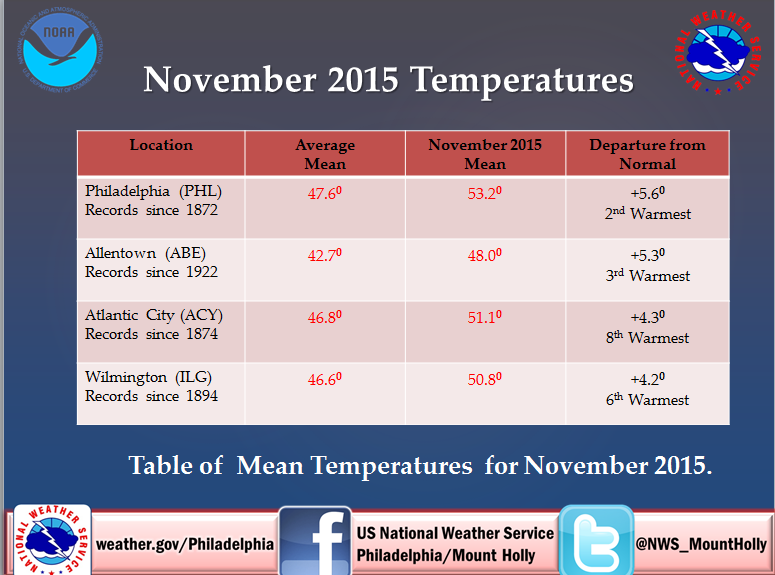
remained rather mild and snowless recently. Philadelphia
saw its second warmest November on record in 2015, and made it through
the autumn to the start of December without a freeze for the first time
since 1939.

For Buffalo, New
York, it was the seventh warmest November on record. Buffalo has also
yet to see accumulating snowfall this season, marking the longest the
city has gone in a snow season without receiving its first measurable
snow.
(MORE: Still No Snow in Buffalo)
The
lack of snowfall and nights below 32 degrees means a tough start for
ski resorts in parts of New England and the Appalachians. Over the Great
Lakes, on the heels of record late-season ice into spring 2015, lake
ice formation may be significantly delayed.
Interestingly
enough, a delay in freezing of the lakes could support a later
lake-effect snow season, as colder air moving over warmer lake water can
lead to the development of heavy snow bands into early winter. This,
however, depends on the ability of substantial moisture to coincide with
sufficient cold air, something that has struggled to happen so far this
season.
(PHOTOS: November 2014 Lake Effect Snow Buries South Buffalo)
It is not just the northeastern quarter of the country that has escaped the bulk of winter’s fury to date.
Florida,
in particular, has been on quite a stretch for above normal
temperatures. In November, Naples and Fort Lauderdale recorded their
warmest November on record. For Miami and West Palm Beach, it was their second warmest November on record.
Fargo,
North Dakota has reached 40 degrees or higher on 258 days so far in
2015. Dating back to 1942, the record is 261 days in 2012, but December
2015 could push them over the edge in just the next week alone.
As
of Tuesday, both Minot, North Dakota and International Falls, Minnesota
had experienced their warmest first week of December on record.
What About Last Winter?
December
2014 was also a warmer than average month for much of the country.
Despite that happening, winter took a fast turnaround in parts of the
Northeast.
The pattern changed
very quickly in the winter of 2014-15 with record-setting snows hitting
parts of New England in January in February.
(MORE: Record New England Snowfall in 2014-15)
There are some differences between this winter and last winter, particularly with the strong El Nino currently in place.
Regardless,
weather patterns are bound to change at some point, so check back
regularly with weather.com for the latest information.
MORE: December Destinations

No comments:
Post a Comment