Typhoon Nangka slammed the Japanese mainland Thursday and continues to do so as a tropical storm Friday, bringing heavy rains and prompting evacuations and travel cancellations. At least 25 people have been injured, and Japanese media reported that two people had died.
The storm's path is likely to bring impacts across all four of the nation's largest islands, and the Japanese Meteorological Agency is warning that some locations could see up to 3 feet (1 meter) of rainfall. Serious flooding occurred in the suburbs of Tokyo as heavy rain fell far in advance of the storm's center on Thursday.
(MORE: Track Nangka)
Fuji TV, a major Japanese television network, says the typhoon has killed two people and injured 20 others. Both reported deaths occurred in Hyogo Prefecture, near Kobe. One victim fell while attempting to cover windows as a precaution against the typhoon's winds. The other death occurred when an elderly person fell off a 100-foot cliff while attempting to view a flood-swollen canal.
In Saitama Prefecture, just north of Tokyo, a resident was swept away in a swollen canal and remains missing, according to NHK.
The Japanese government's Fire and Disaster Management Agency confirmed 25 injuries, four of those serious, as of Friday morning.
Among the seriously injured was a 16-year-old high school student who fractured his foot when high winds blew a soccer goalpost onto him in western Japan's Yamaguchi Prefecture.
The other three serious injuries involved elderly people falling in strong winds – two in Hyogo Prefecture and one in Hiroshima Prefecture.
Fearing landslides, government officials issued a slew of recommendations to evacuate involving more than 450,000 people in 11 of the country's 47 prefectures, according to the FDMA report. More serious evacuation orders were given to some 88,000 people, most of them in Tokushima Prefecture on the island of Shikoku.
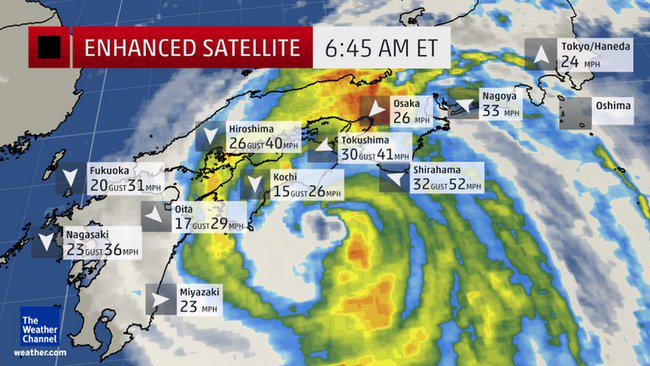

#Typhoon #Nangka Nearing #Japan Landfall; Landslide Warnings Issued, Feet of Rain Expected: http://wxch.nl/1GnSctt
Parts of expressways west of Tokyo were also closed due to high tides and heavy rain, and the region's train operators have also cancelled services.
MORE: Tsunami Devastation in Japan – Before and After

No comments:
Post a Comment